

Faculty of Engineering logoCatholic University of CroatiaFaculty of Engineering

Research

Interdisciplinary research at the intersection of computer science, artificial intelligence, robotics and engineering.

Research areas

Artificial intelligence and data science

Machine learning, computer vision and natural language processing with an emphasis on socially responsible applications.

Robotics and autonomous systems

Research with humanoid robots and robot dogs — human-robot interaction in the real world.

Information security

Protection of data and systems, and ethical questions of privacy in the digital society.

Technology and society

Interdisciplinary research into the impact of digital technologies on people, communities and values.

Projects

Active projects

AntibacHipDevelopment of an innovative antibacterial material for hip endoprostheses

Coordinator
Funding source
NRRP — Targeted Scientific Research
Principal investigator
Prof. Tamara Holjevac Grgurić, PhD
Budget
EUR 1,631,172.52

The project develops an innovative hip endoprosthesis material with improved biofunctionality, antibacterial properties and the ability to prevent biofilm formation on the implant surface, thereby reducing infections after implantation and the need for revision surgery. The Catholic University of Croatia is the lead partner, with the Faculty of Chemical Engineering and Technology and the company Instrumentaria d.d. participating in the project.
BrainClockDevelopment of personalised tests for determining the biological age of the brain and the early detection of dementia

Partner
Funding source
NRRP — Targeted Scientific Research · Contract no.: NPOO.C3.2.R3-I1.04.0089
Duration
2. 1. 2024.30. 6. 2026.
Principal investigator
Prof. Dinko Mitrečić, PhD (School of Medicine, University of Zagreb)
Budget
EUR 1,591,504.70

The project develops glycan-analysis-based tests that quantify the biological age of the brain and identify early signs of pathological ageing. The Faculty of Engineering contributes its expertise in artificial intelligence, and the partners also include the School of Medicine, University of Zagreb, and Genos d.o.o.

AISEAn artificial intelligent platform to support students by assessing their performance skills through predictive models created from their writing skills

Partner
Funding source
Erasmus+ (KA220-SCH) · Contract no.: 2023-1-EL01-KA220-SCH-000157157
Duration
16. 12. 2023.15. 12. 2026.

An international project developing an artificial-intelligence platform for the automated assessment of student essays and the analysis of writing skills, aimed at supporting students and improving teaching processes. The project is coordinated by the Directorate of Secondary Education of Preveza (Greece), with partners from Croatia, Serbia and Cyprus.

DATACROSS 2.0Centre of Research Excellence for Data Science and Cooperative Systems — DATACROSS 2.0

Partner
Funding source
European Regional Development Fund (Centre of Research Excellence)

A continuation of the work of the Centre of Research Excellence for Data Science and Cooperative Systems, researching advanced methods and technologies in data science and cooperative systems. The Catholic University of Croatia participates as a partner institution.

CEEPUS HR-0108Concurrent Product and Technology Development

Coordinator
Funding source
CEEPUS

A Central European CEEPUS network for the exchange of students and teaching staff in the field of concurrent product and technology development, focused on production and industrial engineering and on joint teaching and research programmes of the partner universities.

Completed projects

UNICATH-RESResearch and innovation infrastructure of the Catholic University of Croatia for applied STEM and ICT research

Coordinator
Funding source
EU Recovery and Resilience Facility (NRRP)
Duration
2026.
Budget
EUR 3.3 million

The project established the University research and innovation infrastructure for applied STEM and ICT research — from a data centre and high-performance computing infrastructure to robotics and XR equipment. The results of the project were presented in June 2026.

Results

Infrastructure
  • University Research and Innovation Centre
  • Data centre with the Vivaldi supercomputer and the Speedy AI superserver
  • Robotics equipment — a humanoid robot, robot dogs, service robots and collaborative robots
  • Virtual and mixed reality (XR) system

DATACROSSAdvanced methods and technologies in data science and cooperative systems

Partner
Funding source
European Regional Development Fund — OP Competitiveness and Cohesion (Centre of Research Excellence) · Contract no.: KK.01.1.1.01.0009
Duration
2017.2022.

The Centre of Research Excellence for Data Science and Cooperative Systems brought together 87 leading Croatian scientists from 13 institutions to research advanced methods and technologies for the analysis of heterogeneous data. The Catholic University of Croatia participated as a partner institution.

Research infrastructure

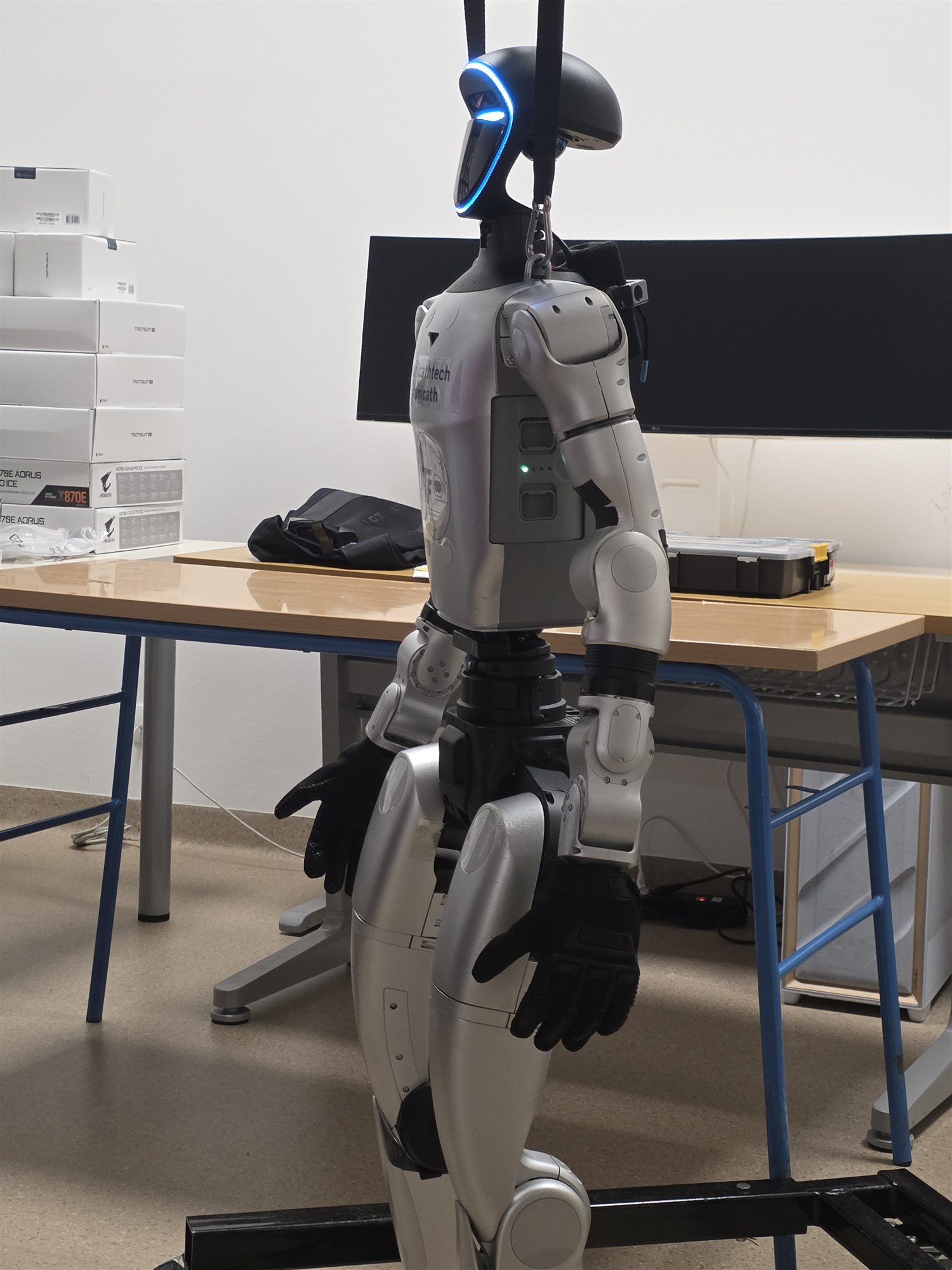
Humanoid robot in the Faculty laboratory

The Faculty operates its own top-tier computing and robotics infrastructure — from the Vivaldi supercomputer and the Speedy AI superserver in the Faculty's own data centre to laboratories with humanoid robots, service robots and an extended reality (XR) system.

Students join research projects on this equipment from their first year, and the Faculty actively develops cooperation with industry and international partners through the Erasmus+ and CEEPUS programmes.

Vivaldi supercomputer

An AI/HPC platform with 8 NVIDIA Blackwell Ultra generation GPU accelerators, 128 processor cores and 2 TB of RAM — computing power in the range of 9 PFLOPS for training and running large language models.

Speedy AI superserver

A server with three professional GPU accelerators, dedicated to AI simulations, computer vision and research projects of students and staff.

Data centre

The Faculty's own on-campus data centre with redundant uninterruptible power (two 60 kW UPS systems on A/B feeds) and a 180 kVA diesel generator — housing Vivaldi, Speedy and the rest of the Faculty's server infrastructure.

Robotics laboratory

A humanoid robot, latest-generation robot dogs, a dual-arm AI robotic system with a vision system, and collaborative robots for human-robot interaction research.

Service robots

Autonomous service (delivery) robots with hemispherical 3D LiDAR sensors for spatial mapping, autonomous navigation and obstacle avoidance.

XR system

A virtual and mixed reality system — VR/MR headsets with haptic vests and VR workstations for immersive simulations, visualisation and interaction with robotic systems.